What are the risk factors?
Age > 45 yrs
Lack of dietary fibers & High protein diet (meat)
Alcoholism, Smoking
Cholecystectomy - increased bile acid secretion
Introduction
It's the commonest malignant tumour of the kidney, also known as hypernephroma.
The peak incidence is around the age of 50-70s, male predominance.
The tumour arises from the renal tubules.
Introduction
Urinary stones are usually divided into 2 types :
The two main disease of the prostate :
1) Benign prostatic hyperplasia (BPH)
In brief, what happens is as men ages (>45 yrs), testosterone levels are reduced and the levels can be relatively lower than the estrogen levels.
Hence, estrogenic effects over the prostate causes proliferation, first over the periurethral region.
Note that as the prostate enlarges, it compresses on and elongates the prostatic urethra. Hence, it results in symptoms of bladder outflow obstruction.
Pathology
Almost all cases of Bladder carcinomas are originating from the transitional epithelium.
Since, the urothelium is frequently exposed to carcinogens that might be excreted through the urine. Urothelium over the bladder is commonly involved since there's always residual urine.
First of all, the causes of hematuria :
What are the common causes of urinary tract obstruction?
Upper UT obstruction :
Renal, ureteric calculi
Pelvi-ureteric junction obstruction
Retroperitoneal fibrosis (idiopathic, malignancy)
Transitional cell carcinoma
Congenital (Ectopic ureter, ureterocele)
Infections (Schistosomiasis, TB)
Some key questions to be asked regarding a swelling (generally)
1. When do you first notice the lump?
REMEMBER, first noticed the lump 3 months ago is not the same as first appeared 3 months ago.
2. How do you notice it?
Below are the 3 commonest answers :
a) It's painful
b) I noticed it accidentally
c) Others told me about it
1) Dermoid cyst
Dermoid cyst is a cyst located deep to the skin and lined by the skin.
It forms either due to accident during antenatal development or even following injury, some skin is being implanted into the subcutaneous tissue.
Hematemesis means vomiting of blood.
It can be either a frank blood, or altered, coffee-ground coloured blood (altered by digestive enzyme)
The aetiology of hematemesis is usually proximal to the duodenojejunal junction.
Rectal bleeding usually indicates lower GI bleeding (below duodenojejunal junction). Bear in mind that any patient, aged >45 yrs old, with complaints of :
colickly abdominal pain, PR bleeding and changes in bowel habits
Colorectal CA must be considered unless proven otherwise.
Anatomy of the portal system :
The portal vein is formed behind the neck of pancreas, at the level of L2, by the superior mesenteric and splenic veins.
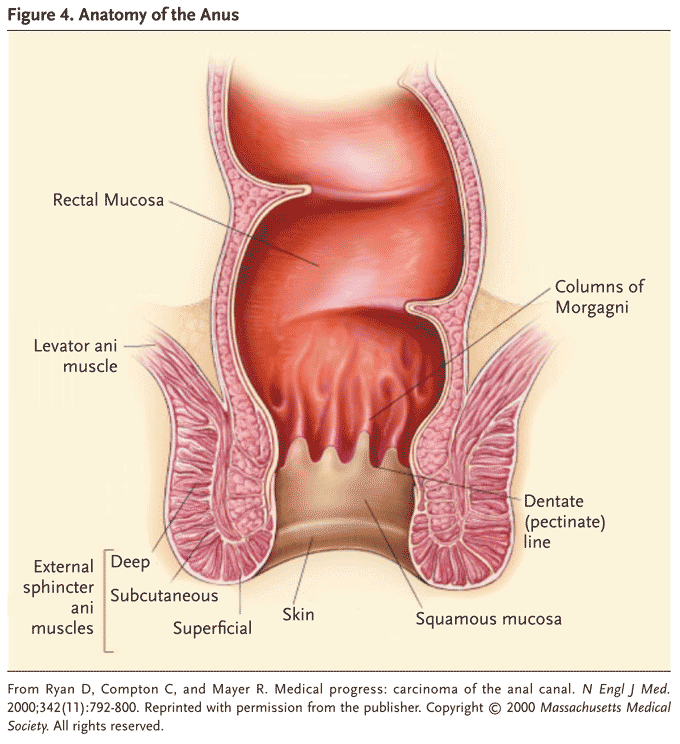
Briefly about anatomy of anal canal
The anal canal commences from the level where the rectum passes through the pelvic diaphragm towards the anal verge. The junction in between the anal canal and rectum is the anorectal ring/bundle which can be felt during PR examination.
Classifications
1) Congenital
Congenital hydrocele
Congenital indirect inguinal hernia
2) Inflammatory
Cellulitis of scrotal skin - skin appears red, shinny, warm, tender
Pyocele - pus accumulation within tunica vaginalis, fluctuates, non-transilluminant
As Housemen, you need to know about the indications, preparations, complications
Oesophagogastroduodenoscopy (OGDS)

In all trauma cases, the 1st hour is also known as the golden hour, since nearly 30% of death occurs during this period of time.
In the ATLS Protocol, it comprises of :
Primary surveilence - Management of immediately life threatening conditions
Secondary surveilence
Definite management

An ulcer is defined as a break in the continuity of the lining epithelium of tissue. Once an ulcer appears, it's usually noticed by the patients, unless it's painless, or located at non-accessible sites.
History taking
1) When do you notice the ulcer?
Remember that the ulcer might have been present for long before the patient actually notices it. This is usually in case of a neuropathic ulcer.
2) What draws your attention to the ulcer?
Usually is because of pain. Others includes : bleeding, discharge, may be foul-smelling.
Just breifly describe about this uncommon, but important condition
First, we'll talk about the anatomy :
Testes are originally retroperitoneal organs, during intra-uterine life.
Just before guys are born, our balls descends down, through the inguinal canal, and enters the scrotal sac at the perineum.
Pathophysiology
90% of the brain metabolism requires blood-borned glucose.
During normal circumstances, the cerebral autoregulation mechanism maintains the cerebral blood flow above 70mmHg, even though the Mean Arterial Pressure (MAP), varies as much as between 50mmHg - 150 mmHg.
This refers to collection of blood in between the skull and dura mater.
More commonly seen in younger patients (children, adolescence)
Extradural hematoma is always associated with skull fractures, most frequently, the temporal bone. (since pterion is the thinnest part of skull, involvement of this area causes tearing of the middle meningeal artery)